report UNM-4471
AI Probability: 79%
Immagine molto probabilmente generata o rigenerata da AI
Uthentic Forensic v0.9 · 4 modelli + lettura fotografica
Truth rate
Complement of the calibrated AI Probability: how far the collected evidence supports authentic content.
Declared accuracy per comparment
- Imagesnot measured yet
- Textnot measured yet
Comparment accuracy is published only after a validated Uthentic benchmark run on a human-labelled dataset.
AI-generated or a real photo that was edited?
Evidence points to generative synthesis: the image did not come from a sensor.
Generative origin
79%
Software processing
0%
The detected artefacts are typical of generative models (frequency structure, light coherence, micro-texture) rather than of an editing chain. This is not a retouched photograph.
Retouching, filters, HDR, upscaling and compositing are software edits applied to a real image — they are not AI generation. Uthentic measures them on a separate axis so an edited photo is never called fake.
Calibrated score
raw
87%
calibrated
79%
- 50%
- agreement
- 4/4
- evidence
- 49%
- reliability
Consistent signs of AI generation, but not proof: source verification is needed. Reliable interval 75-83%, reliability low.
Raw score 87% recalibrated to 79% (-8 points). Model agreement 50%, 4/4 evidence families covered, temperature 1.55: the more the models disagree, the more the score is pulled toward 50% instead of staying artificially extreme.
Measured file evidence
First level: what is measured, not what a model sees.
Generative origin
79%
How much the image looks created by AI, rather than shot with a camera.
File integrity
—
Not AI: measures how much a real photo appears edited with software (Photoshop, filters, compositing). A high value here does not mean the image is AI-generated.
No measurable evidence in this file: the verdict rests on visual reading only.
Model visual reading: secondary explanation.
Content Credentials (C2PA)
Provenance declared by the file under the C2PA standard.
Status
Absent
No provenance manifest in the file: this is not evidence against authenticity, many platforms strip it on re-sharing.
Most recognizable areas
Tap a box to read what gives that area away.
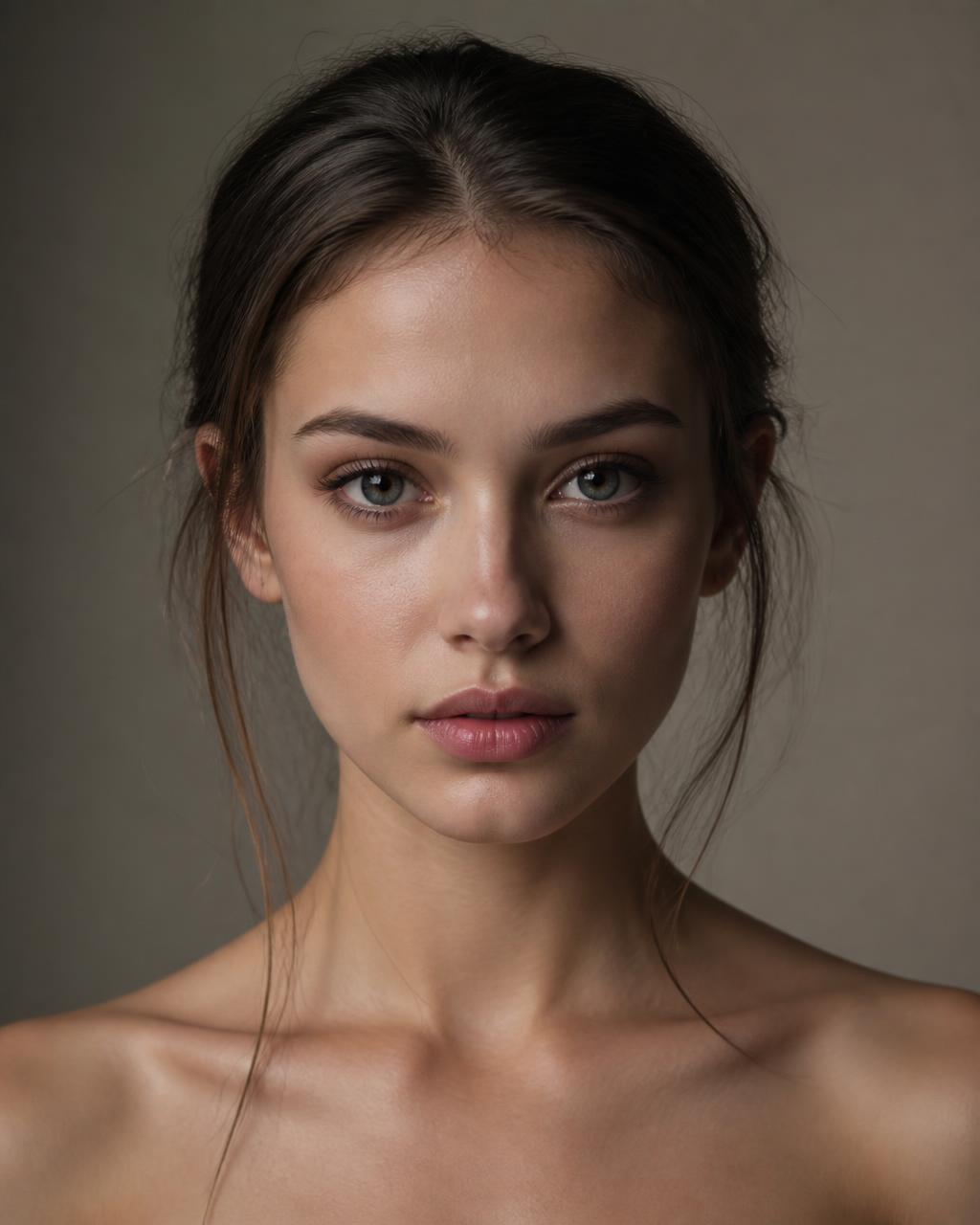
Occhi · catchlight
Pinch on a trackpad, or hold Ctrl/Cmd and scroll, to zoom · double-tap to see the whole image again.
Pixel activation map
Where models and forensic measurements find the highest probability of alteration. Maps are computed on your device, from the image you analysed.
Computing maps…
Where deception is most likely
Areas and conditions where this image can mislead the eye and the detectors' reading.
Most deceptive areas
Occhi · catchlight
94%Riflessi speculari clonati: stessa forma, stesso angolo, stessa dimensione in entrambi gli occhi.
Pelle · microtessitura
88%Pori con distribuzione troppo regolare; il grano non varia con la luminanza come farebbe un sensore reale.
Attaccatura capelli
79%Transizione capelli/sfondo pittorica, senza ciocche isolate né aliasing tipico dell'ottica.
Light and shooting conditions
- Flat, diffuse light with no identifiable source: shadows and reflections cannot be verified.
- Inconsistent or mixed light sources: direction and colour temperature disagree between subject and background.
- Very shallow depth of field: the blur hides the edges and micro-detail where optics are read.
- Smooth matter (skin, fabrics): micro-texture is too uniform to compare against sensor grain.
Context and file history
- Recompressed or resized file (sharing, screenshot, export): the original compression markers are weakened.
- Possible double capture (a print or screen re-photographed): the second capture covers the traces of the first.
Detector matrix · areas, signals and confidence
For each risk area: the specific signals observed, the detectors competent on that kind of evidence and the confidence of the reading.
| Area | Signal | Detector | Confidence |
|---|---|---|---|
| Occhi · catchlight94% | Coerenza sorgente luminosa91% · Light | Uthentic Vision-L, LumaTrace | 83%high |
| Occhi · catchlight94% | Firma ottica e bokeh84% · Optics | Uthentic Vision-L, OpticNet | 78%high |
| Occhi · catchlight94% | Grana e rumore del sensore82% · Material | Uthentic Vision-L, GrainID | 76%high |
| Pelle · microtessitura88% | Coerenza sorgente luminosa91% · Light | Uthentic Vision-L, LumaTrace | 83%high |
| Pelle · microtessitura88% | Firma ottica e bokeh84% · Optics | Uthentic Vision-L, OpticNet | 78%high |
| Pelle · microtessitura88% | Grana e rumore del sensore82% · Material | Uthentic Vision-L, GrainID | 76%high |
| Attaccatura capelli79% | Coerenza sorgente luminosa91% · Light | Uthentic Vision-L, LumaTrace | 83%high |
| Attaccatura capelli79% | Firma ottica e bokeh84% · Optics | Uthentic Vision-L, OpticNet | 78%high |
| Attaccatura capelli79% | Grana e rumore del sensore82% · Material | Uthentic Vision-L, GrainID | 76%high |
| Clavicole · anatomia66% | Coerenza sorgente luminosa91% · Light | Uthentic Vision-L, LumaTrace | 83%high |
| Clavicole · anatomia66% | Firma ottica e bokeh84% · Optics | Uthentic Vision-L, OpticNet | 78%high |
| Clavicole · anatomia66% | Grana e rumore del sensore82% · Material | Uthentic Vision-L, GrainID | 76%high |
Why it shows signs of AI generation
With an AI Probability of 79%, these are the elements that together point to AI generation or regeneration.
Strongest clues
Coerenza sorgente luminosaLight · 91%
Ricostruendo le normali del volto, la luce arriva da 40° a sinistra; le ombre del collo però indicano una sorgente frontale. Due geometrie incompatibili nella stessa scena.
Firma ottica e bokehOptics · 84%
Nessuna aberrazione cromatica ai bordi, nessuna vignettatura, sfocato costante su tutto lo sfondo: non esiste obiettivo che si comporti così.
Grana e rumore del sensoreMaterial · 82%
Il rumore è uniforme sui tre canali RGB e non aumenta nelle ombre: opposto al comportamento di un sensore CMOS.
Photographer's eye
Da fotografo: la luce non ha una sorgente coerente. Il catchlight negli occhi è identico in forma e posizione, cosa impossibile con una finestra reale e un volto non perfettamente frontale. Le ombre sotto il mento sono troppo morbide rispetto al contrasto sulla guancia, come se ci fossero due softbox che non producono però alcuna doppia ombra. La caduta di nitidezza dai capelli allo sfondo non segue una curva di sfocato ottica: manca il progressivo bokeh e i bordi dei capelli sfumano in modo pittorico invece di frammentarsi in ciocche.
Photographer's reading
Da fotografo: la luce non ha una sorgente coerente. Il catchlight negli occhi è identico in forma e posizione, cosa impossibile con una finestra reale e un volto non perfettamente frontale. Le ombre sotto il mento sono troppo morbide rispetto al contrasto sulla guancia, come se ci fossero due softbox che non producono però alcuna doppia ombra. La caduta di nitidezza dai capelli allo sfondo non segue una curva di sfocato ottica: manca il progressivo bokeh e i bordi dei capelli sfumano in modo pittorico invece di frammentarsi in ciocche.
re-capture module
Se una foto AI viene stampata e rifotografata, i marcatori di compressione e i metadati sparirono: in quel caso Uthentic pesa di più la lettura fotografica (luce, ottica, materia) e segnala la doppia acquisizione con il modulo Re-capture.
Plausible camera
Nessuna firma di fotocamera riconoscibile
- lens
- resa ottica non attribuibile a un obiettivo reale
- estimated settings
- profondità di campo non compatibile con una focale fisica
- attribution
- 18%
- why
- La firma di rumore è uniforme sui tre canali e la caduta di nitidezza non segue nessuna curva ottica nota: non è possibile ricondurre l'immagine a un corpo macchina plausibile.
Analyzed signals
Ensemble models
89%
Uthentic Vision-L
classificatore generativo
84%
OpticNet
coerenza ottica e bokeh
91%
LumaTrace
ricostruzione luce 3D
80%
GrainID
rumore e firma sensore
Dettaglio tecnico
- Provenienza nei metadati originali
- nessun metadato di origine
- Letture indipendenti
- 4 · scarto 11 punti
- Affidabilità
- 49% · bassa
- Evidenza
- insufficiente
Signal glossary
How to read the matrix terms: what each signal measures and how to interpret it against the lighting and the shooting context.
- Light and shadows
- Consistency of light direction, shadow softness, eye catchlights and specular highlights.
- A single credible source produces consistent shadows: shadows falling in different directions, flat light with no falloff or missing catchlights point to a constructed scene rather than a real environment.
- Optics and perspective
- Lens behaviour: progressive defocus, edge aberrations, distortion, vanishing lines and focus plane.
- With a real focal length blur grows with distance and perspective stays unique: uniform bokeh, overly clean edges or inconsistent vanishing lines betray a synthesised context rather than a captured one.
- Matter and grain
- Sensor grain, micro-texture of skin, fabrics and surfaces, local noise and genuine detail sharpness.
- Sensor noise is uniform across the frame and rises in the shadows: smoothed textures, grain missing in dark areas or repeating detail signal generated matter.
- Row confidence
- How solid the area-signal-detector link is: it weighs signal strength, agreement among competent detectors and the overall reliability of the report.
- High confidence means several independent readings see the same thing in the same area; low confidence suggests re-checking that area with a second shot in different light.